
By: Savanna Vidal, MD
Study background
For patients with severe hidradenitis suppurativa (HS), biologics (medicines typically administered as injections or infusions) are among the most widely used treatments. Although biologics can be highly effective, their high cost and inconsistent insurance coverage limit access for many patients. Biosimilars were developed to help address this gap by offering a lower-cost alternative.
You can think of a biosimilar as similar to a generic version of a name-brand drug. Like generics, biosimilars are designed to be just as safe and effective as the original biologic. However, because of minor differences in how they are manufactured, there is a small possibility that your body may respond to them differently.
One of the most commonly used biologics for HS is adalimumab (brand name: Humira), which now has several biosimilar versions available.
Purpose of the study
This study examined whether patients with HS responded differently to the original adalimumab (Humira) compared to a biosimilar version, and whether one maintained its effectiveness longer than the other over time.
How the study was done
Researchers looked at patients with HS at three different clinics over ~3.5 years. Patients were split into two groups:
- New to biologics (“biologic-naïve”): These patients had never taken a biologic before. Some started on the original adalimumab, and some started on a biosimilar.
- Switchers: These patients had been doing well on the original adalimumab for at least 16 weeks, then switched to a biosimilar.
Patients could still use other HS treatments during the study.
Researchers tracked treatment response using standard HS scoring tools, which measure improvement by counting active lesions such as bumps, abscesses, and draining tunnels.
Key findings
Group 1: 313 biologic-naïve patients (new to biologics)
- At 4 months (week 16), both groups improved, but patients on original adalimumab had a greater degree of improvement.
- Similar numbers in both groups saw their HS improve by 50% or more.
- More patients on the original saw their HS improve by 75% or more.
- At 1 year (week 52), patients on original adalimumab had more improvement of their HS and were less likely to stop responding to treatment.
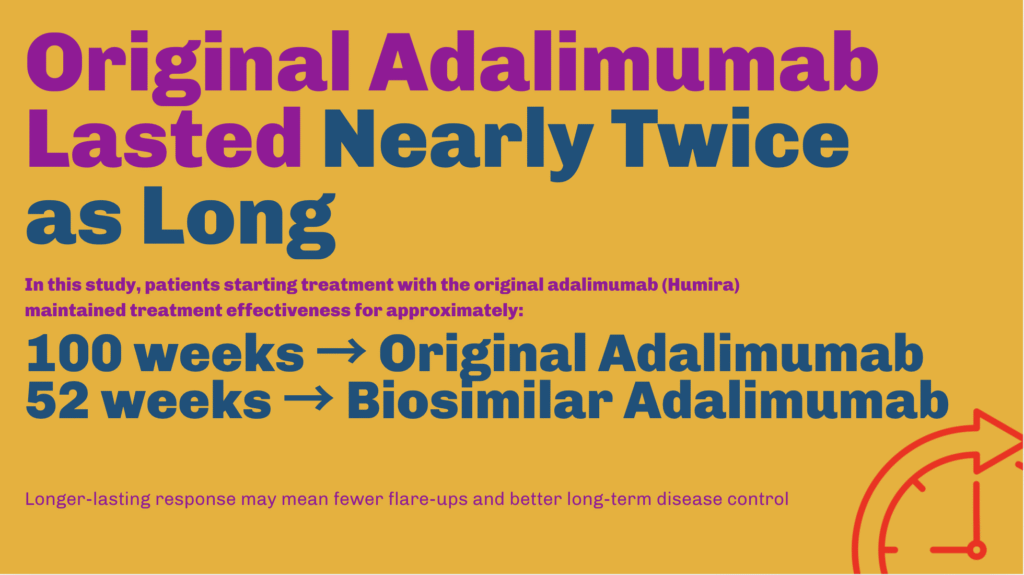
- On average, the original adalimumab worked for twice as long as the biosimilar: original → 100 weeks, biosimilar → 52 weeks
- Patients on the biosimilar had a 77% higher odds of stopping responding to treatment compared to those on the original.
Group 2: 71 patients that switched from original adalimumab to a biosimilar (compared to 71 patients who stayed on the original)
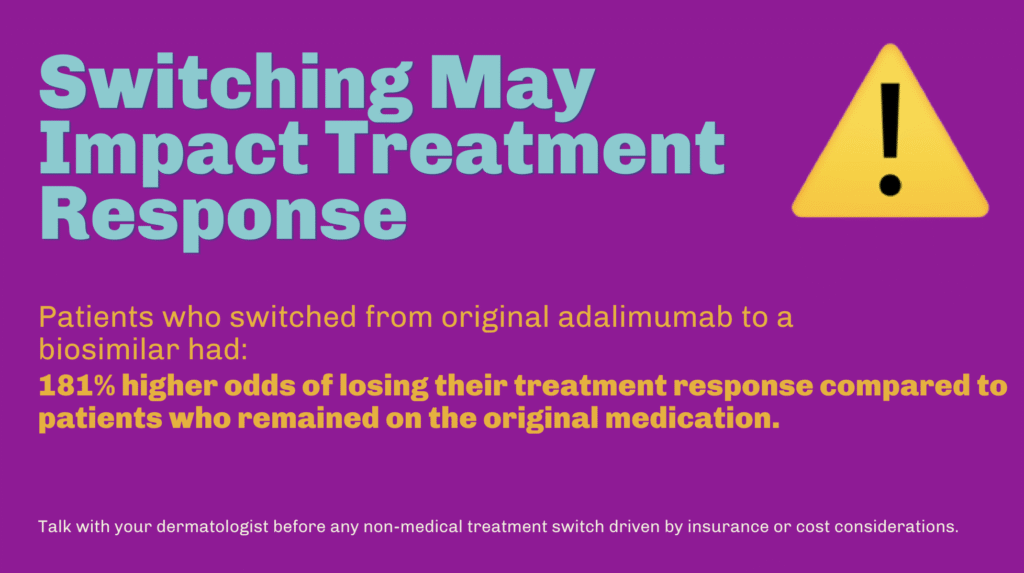
- Patients who switched had a 181% higher odds of losing their response to treatment.
- After switching from the original adalimumab to the biosimilar, the medicine stopped working much sooner: about 50 weeks for switchers compared to 87 weeks for those who stayed on the original.
Limitations of the study
This study included a relatively small number of patients, so larger studies are needed to confirm these findings.

Key takeaway points
- If you are starting a biologic for the first time, this study suggests the original adalimumab (Humira) may better control HS and keep HS under control longer than a biosimilar version.
- If the brand-name medication isn’t an option, that doesn’t mean a biosimilar won’t work well for you. In fact, approaching treatment with a negative expectation can itself cause stress, which may independently worsen HS symptoms.
- You have a voice in your treatment. If you are doing well on the original adalimumab, talk to your dermatologist before any nonmedical switch is made that is driven by cost or insurance.
- If your insurance wants to switch you to a biosimilar, studies like this can be used to advocate for you staying on the brand name treatment (as long as it can be done safely).
References
- Kimball AB, Sobell JM, Zouboulis CC, Gu Y, Williams DA, Sundaram M, Teixeira HD, Jemec GB. HiSCR (Hidradenitis Suppurativa Clinical Response): a novel clinical endpoint to evaluate therapeutic outcomes in patients with hidradenitis suppurativa from the placebo-controlled portion of a phase 2 adalimumab study. J Eur Acad Dermatol Venereol. 2016 Jun;30(6):989-94. doi: 10.1111/jdv.13216. Epub 2015 Jul 22. PMID: 26201313; PMCID: PMC5034809.
- Tzellos T, van Straalen KR, Kyrgidis A, Alavi A, Goldfarb N, Gulliver W, Jemec GBE, Lowes MA, Marzano AV, Prens EP, Sayed CJ, van der Zee HH, Zouboulis CC. Development and validation of IHS4-55, an IHS4 dichotomous outcome to assess treatment effect for hidradenitis suppurativa. J Eur Acad Dermatol Venereol. 2023 Feb;37(2):395-401. doi: 10.1111/jdv.18632. Epub 2022 Oct 19. PMID: 36184889.