
By: Savanna Vidal, MD
Content warning: This article discusses food, weight, and obesity as they relate to medical research and hidradenitis suppurativa.
Study background
Doctors do not yet fully understand what causes hidradenitis suppurativa (HS). Genetics, obesity, skin rubbing (friction), stress, and diet are known to play a role. Inflammation in the body also plays a role. Inflammation is how the body responds to injury or infection. It helps protect us, but too much inflammation can make HS symptoms worse.
Researchers are also studying whether chemicals from plastic containers used to store or heat food may add to inflammation in the body. Tiny plastic particles (called microplastics) found in some processed foods may also play a role. More research is needed to know if these factors affect HS.
People with HS often hear many different suggestions about what to eat, what to avoid, and how to prevent flares. Studies like this help researchers learn which lifestyle changes may be the most helpful, so patients can focus on what is most likely to make a difference in their HS.
Purpose of the study
Dermatologists at Johns Hopkins in Baltimore, Maryland, noticed that HS diagnoses seemed to increase over the past 20 years. They wanted to learn whether lifestyle and environmental factors might help explain this trend.
The researchers looked at whether diet, plastic use, and sweating were different in patients with and without HS.
How the study was done
Researchers conducted a study involving 40 adults: 20 patients with HS and 20 ‘healthy controls’ (healthy controls in research studies are individuals without the condition being studied). Participants completed surveys about their demographics (age, gender, income, race, and education), lifestyle habits (diet, food preparation and storage), and disease history (sweating patterns, HS symptom triggers). They also had a physical examination by a medical professional.
Key findings
- Compared with controls, participants with HS reported eating fewer home-cooked meals and consuming more meals prepared outside the home. They also drank canned beverages more frequently.
- Patients with HS were more likely to report microwaving food in plastic containers and using single-use plastic water bottles.
- Participants identified sweating (80%), stress (60%), and fast food and canned beverages (50%) as the most common factors worsening their HS.
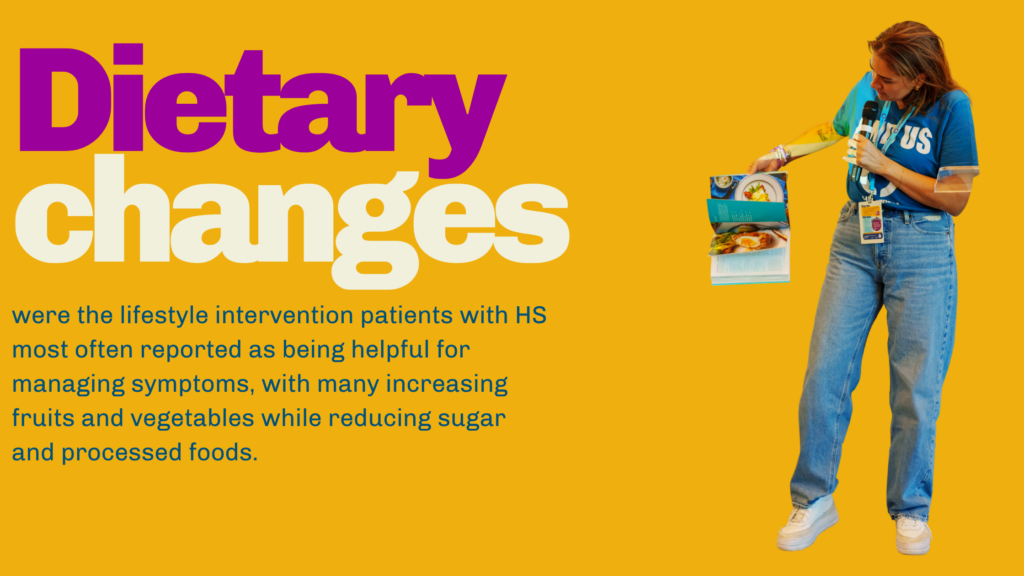
- Diet was the lifestyle change most often reported to help manage HS symptoms. More than 80% of participants found dietary changes helpful, and 41.17% ranked diet as the single most helpful intervention.
- Common diet changes included increasing fruits and vegetables while reducing sugar and processed foods.
- People with HS also reported sweating more often, especially in areas where they had active HS lesions, such as the groin and abdominal folds.
Limitations of the study
- This was a small study at a single medical center with only 40 participants, so the results can not be applied to everyone with HS until larger studies are done.
- Other things, like gender, income, race, and weight, may influence the differences observed between the two groups. These are called ‘confounders.’
- Most importantly, while this study found links between lifestyle factors and HS, it did not show that these factors cause HS or make it worse.

Key takeaway points
- This study suggests that individuals with HS may have different eating habits, plastic use, and lifestyle behaviors compared with people without HS.
- The findings support common lifestyle advice for people with HS, including:
- Preparing more meals at home, eating more fruits and vegetables, and limiting processed foods, fast food, and sugar-containing beverages.
- Using glass or ceramic containers instead of plastic when reheating food and choosing reusable water bottles when possible.
- For more information on nutrition in HS, here is a resource from HS Connect: https://hsconnect.org/nutrition/
- While weight can play a role in HS, this study suggests sweating may also be important. The researchers think chemicals from plastics or processed foods could leave the body through sweat and possibly increase inflammation. This idea has not been proven and needs more research.
- Overall, this study suggests that nutrition, environmental exposures, and other lifestyle factors may play a role in HS. Larger studies are needed to learn whether these factors truly affect HS or are simply linked to it.