
By: Savanna Vidal, BS , M.D. Candidate | The George Washington University School of Medicine
Study background
HS can look and act differently in each person. Early treatment is important because untreated HS can lead to long-term changes in the skin that cannot be reversed, like tunnels or scarring.
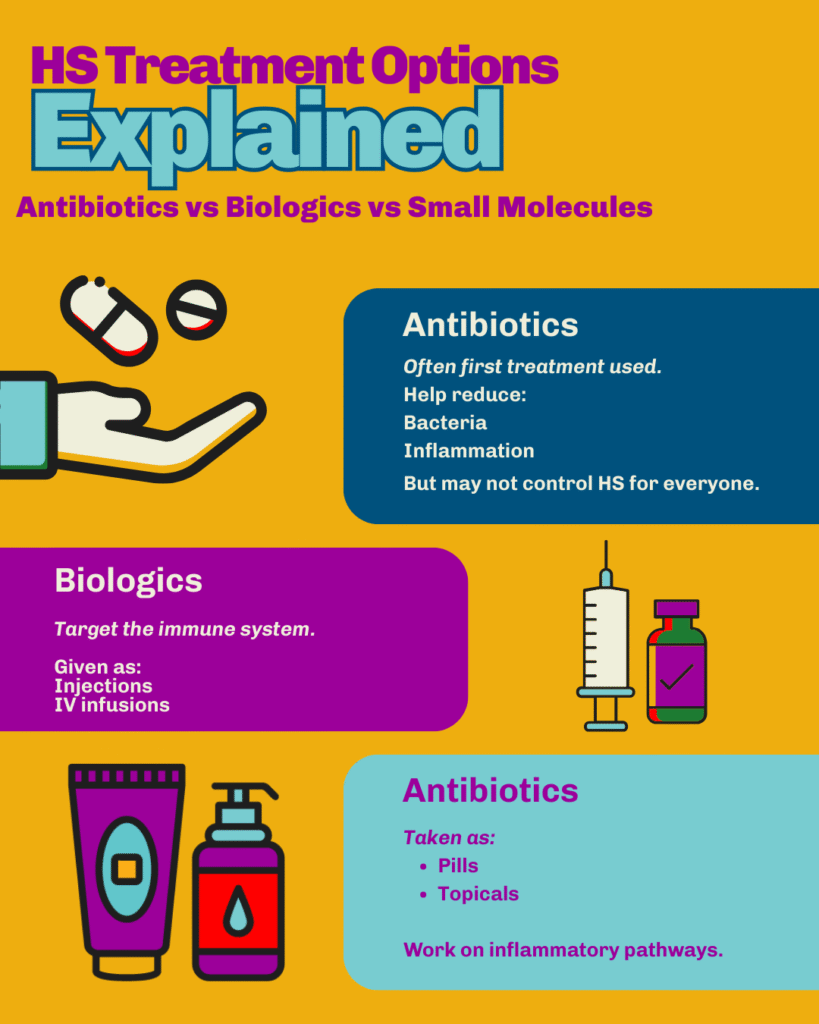
Antibiotics are often used first to treat HS because they reduce bacteria and inflammation, but they may not fully control the disease for everyone. Stronger treatments, including biologics (injections like adalimumab, secukinumab, bimekizumab) and small molecules (pills or topical medications like apremilast, ruxolitinib, upadacitinib), can be more effective in achieving disease control in some situations.

Purpose of the study
The study looked at when biologics or small molecules should be used as the first treatment or when a patient’s treatment should be upgraded to these stronger options to better control HS.
How the study was done
- 54 HS experts participated in a Delphi consensus, a structured study process to reach agreement on statements about treating patients.
- Experts voted on 16 statements about when to use biologics or small molecules first or as an upgraded treatment in patients not responding to their current treatment. Statements were considered valid if ≥70% of experts agreed, consensus if ≥75%, and strong consensus if ≥90%.
Disease severity scales used in the study
- IHS4: counts nodules, abscesses, draining tunnels (mild ≤3, moderate 4–10, severe ≥11)
- Hurley staging: Focuses on scarring and tunnels (Stage I–III)
Key findings
- If antibiotics cannot be used for a patient, start biologics or small molecules first.
- For moderate to severe HS, stronger treatment may be needed even if scarring or tunnels haven’t formed.
- For rapidly worsening HS, early stronger treatment may be needed.
- For patients with frequent flares or multiple areas with HS lesions, a stronger treatment may be needed even if there are few lesions.
- If HS causes significant discomfort or impacts daily life, stronger treatment may be needed.
- Certain types of HS and HS in the groin, genitals, or visible areas (like the face) may need early stronger treatment.
- If HS is occurring as part of a syndrome, early stronger treatment may be needed, even if no genetic cause is known.
- Patients with HS plus conditions like inflammatory bowel disease or axial spondyloarthritis may need early stronger treatment.
- Early-onset HS in children and adolescents with a family history of HS may need early, stronger treatment.
Limitations of the study
This study reflects expert opinion, not direct patient-based research. More studies are needed to confirm these recommendations. Some experts had conflicts of interest but were included for their knowledge of HS.
Patients were not involved in this study.
Key takeaway points
Stronger treatments like biologics or small molecules may need to be used earlier in many situations to better control HS and prevent long-term, irreversible skin changes.
Sharing your symptoms, flares, pain, and how HS affects daily life helps your doctor choose the best treatment. While the study reflects European guidelines, it may influence care in the U.S. in the future.
If any of these situations apply to you, speak up! Your experiences matter and can guide your care.
Download the full study here.